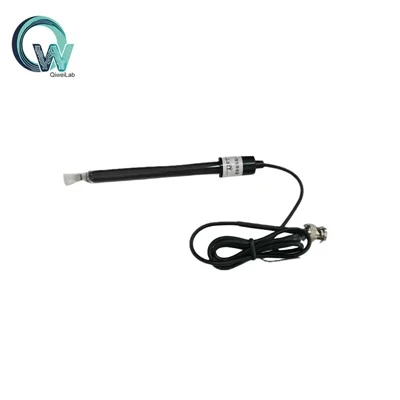
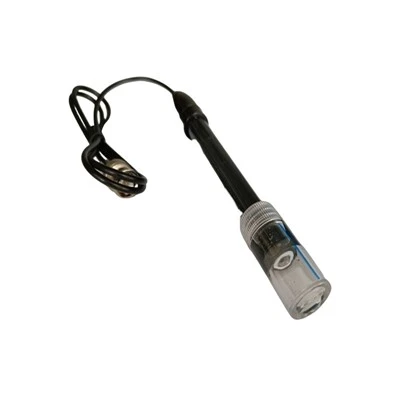
Hangzhou Qiwei Instrument Co., Ltd. is one of the leading manufacturers and suppliers of ph composite electrode in China. With a professional production team, we are able to meet the needs of the majority of our customers. Welcome to wholesale bulk ph composite electrode in stock here from our factory. We also accept customized orders.
Laboratory Glass pH Composite Electrode
For easy measurement of aqueous samples, a laboratory glass pH composite electrode integrates the pH sensor element and reference system into a single probe.
It is intended for use in chemical research, routine water analysis, laboratory testing, teaching, and other applications where users need a specific pH electrode to connect to a suitable pH meter.
The reference system, filling solution, junction material, sample temperature, and measurement conditions can all influence the electrode arrangement.
product key technologies

A silver-chloride silver reference electrode and a pH-sensitive glass electrode make up this pH composite electrode. Due to the use of plastic as the outer shell, it has superb light-blocking properties and is not prone to breakage. It doesn't require an extra reference electrode in order to test the pH of aqueous media.
Details
|
Model |
E201-C |
|
pH Range |
0~14PH |
|
Media Temp |
5~60°C |
|
Internal Resistance |
≤120 MΩ (at 25°C) |
Models & Capabilities
|
Model |
87-1 |
92-1 |
92-1A |
92-2 |
92-2A |
|
Zero-potential PH Value |
7±1PH |
7±1PH |
2±1PH |
7±1PH |
2±1PH |
|
Total Length (including electrode cap) |
Approximately 78mm |
Approximately 160mm |
|||
|
Joint Type |
Special plugs are directly attached to the electrode caps |
With connecting wires and universal plugs |
|||
|
Additive Liquid |
No need |
3.3NKCl saturated with AgCl |
|||
Notes
- The electrode should be placed into the protective container, the bottle lid should be fastened, and it should be kept sealed while not in use.
- During use, the liquid contact parts of the bulb and the external reference electrode should be fully immersed in the measurement media. When measuring another media, it is necessary to first clean them in distilled water to prevent impurities from being carried into the media.
- Fill the electrode protection cap with 3.3NKCl solution.
- Non-aqueous medias cannot be utilized with the pH composite electrode.
- The electrode plug's insulating portion has to be maintained dry and clean.
- When the electrode cap's special plug is plugged into the socket. Any issues with poor conductivity that can arise after prolonged usage must be avoided. If not, there will be problems like inaccuracy and unpredictable variations in the instrument's numbers. If this phenomenon is identified, the elastic spring within the plug (or socket) can be moved gently toward the center with a needle to ensure secure contact.
How to Activate a New pH Composite Electrode?
Before making its first measurement, a fresh or dry-stored pH electrode might need to be conditioned.
Step 1: Examine the electrode
Look for obvious damage on the glass membrane, junction, body, cable, and connector.
Step 2: Rinse
Without wiping the glass membrane, gently remove any excess water from the detecting area after rinsing it with clean distilled or deionized water.
Step 3: Hydrate the Glass Membrane
For the duration indicated by the electrode manufacturer, submerge the sensing section in the suggested conditioning or storage solution.
Step 4: Get the Reference System Ready
Verify the filling solution level and the quality of the reference junction if the electrode has a refillable reference system.
Step 5: Adjust
Before measuring the sample, calibrate it using the proper pH buffer solutions.
Step 6: Measure
Before recording the outcome, rinse the electrode in between samples and let the reading stabilize.
This conditioning process lessens measurement instability brought on by a dry or incorrectly conditioned sensing membrane and aids in establishing a constant electrode response.
When Should the Electrode Be Reconditioned?
Reconditioning or recalibration may be appropriate when:
1.The electrode has been stored dry.
2.Response becomes noticeably slower.
3.Calibration slope changes significantly.
4.Readings become unstable.
5.The electrode has been exposed to heavily contaminated samples.
6.The electrode has remained unused for an extended period.
If performance does not recover after proper cleaning and conditioning, the electrode should be inspected for membrane or reference-junction damage.
FAQ
1.What is a glass pH composite electrode used in laboratories?
It is a pH and reference electrode that may be used with a suitable pH meter to measure the pH of aqueous samples.
2.Which reference electrode is most frequently utilized?
A popular reference system for pH electrodes in laboratories is Ag/AgCl. A double-junction arrangement could be advantageous for some applications.
3.What is 3M KCl used for?
In reference systems, KCl is frequently utilized as the electrolyte. In appropriate laboratory reference settings, a 3M KCl filling solution can be utilized.
4.What distinguishes PTFE connectors from ceramic junctions?
While PTFE offers more chemical resistance for certain demanding sample conditions, ceramic connections are frequently utilized for typical watery samples.
5.What is the best way to store a pH composite electrode?
In general, the manufacturer's suggested storage solution should be used to keep the sensing membrane moist. Unless the electrode is made especially for dry storage, it should not be kept dry.
Hot Tags: ph composite electrode, China ph composite electrode manufacturers, suppliers, factory, Conductivity Sensor Element, electrode, Industrial Online PH Electrode, Ion Selective Electrode, PH Corrosion Resistant Electrode, PH Flat Electrode