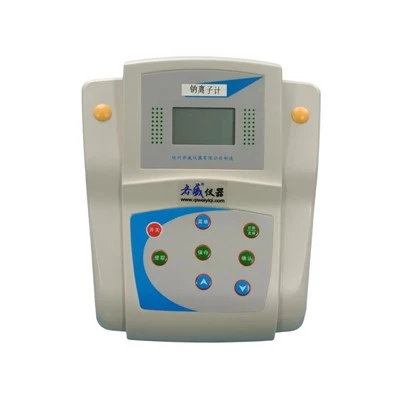
Hangzhou Qiwei Instrument Co., Ltd. is one of the leading manufacturers and suppliers of portable multi-parameter kalium ion concentration meter in China. With a professional production team, we are able to meet the needs of the majority of our customers. Welcome to wholesale bulk portable multi-parameter kalium ion concentration meter in stock here from our factory. We also accept customized orders.
Portable Potassium Ion Measurement for Agriculture and Hydroponic Applications
The potassium (K+) concentration in agricultural and environmental samples can be quickly measured using the portable potassium ion meter.
The device monitors the concentration of potassium ions directly using a potassium ion selective electrode (K+ ISE) in:
Extracts from soil
Nutrient solutions using hydroponics
Solutions for fertilizer
Samples of plant sap
Water for agriculture
Growers, agronomists, and researchers may conduct potassium analysis in the field without waiting for laboratory testing thanks to the handheld design.
Users can monitor fertilizer conditions, assess crop nutrition status, and optimize nutrient management with the aid of portable potassium measurement.
product key technologies

Engineered with an all-in-one streamlined framework, the portable multi-parameter kalium ion concentration meter features miniaturized build and superior portability, tailored specifically for movable water quality monitoring work. Boasting expedited analytical capability, the unit efficiently quantifies potassium ionic content in various aqueous samples. It perfectly accommodates flexible non-fixed operation modes such as wilderness specimen collection, open-air investigation and daily field screening, acting as an ideal testing device for on-site mobile analysis.
Featuring user-friendly visual control logic, the equipment eliminates tedious setup and calibration procedures, allowing immediate use with minimal maintenance expenditure. In line with global industrial testing criteria, it supports diversified application domains, including collegiate experimental studies, institutional physicochemical assays, power station water regime regulation, petrochemical production and high-precision electronic fabrication. Integrated with premium high-precision sensing components, the device possesses outstanding analytical sensitivity and data consistency, capable of conducting standardized physicochemical evaluation for all types of water mediums.
Working condition
|
Ambient Temperature |
(5~40)℃ |
|
Relative Humidity |
≤80% |
|
Power supply |
4×AAA alkaline batteries |
|
Interference |
There is no interference from other magnetic fields except the Earth's magnetic field |
|
Vibration |
No significant vibration |
Technical parameters
|
Model |
BXS-K |
|
Measuring range |
pK: (0.00~6.00)pK; K+: 0.19μg/L~19g/L; mV: (-1800~1800)mV |
|
Resolution |
0.01pK |
|
Basic Error of the Electronic Unit |
±0.02pK ±1 word |
|
Instrument Basic Error |
±0.05pK |
|
Calculation Error |
±0.3% |
|
Repeatability Error |
≤±0.03pK ±1 word |
|
Stability of the Electronic Unit |
±0.02pK/3h |
|
Temperature Compensation Range |
(5.0~50.0)℃ |
|
Size |
80×85×30mm |
|
Weight |
1KG |
Step-by-Step Potassium Field Measurement
1. Gather test specimens including soil leachate, nutrient liquids or plant sap.
2. Complete calibration for the potassium‑ion sensor with corresponding standard reagents.
3. Submerge the electrode into the pre‑processed specimen liquid.
4. Hold until the displayed value becomes steady.
5. Document the detected potassium concentration figures.
Thanks to this uncomplicated testing sequence, operators can finish potassium‑ion analysis on‑site at farmland, greenhouse facilities and field research locations.
Request Portable Potassium Testing Solution
Different agricultural applications may require different:
1.Potassium measurement ranges
2.Electrode configurations
3.Standards for calibration
4.Sample preparation methods
Provide your application details:
1.Soil testing
2.Hydroponic farming
3.Fertilizer management
4.Plant nutrition research
Our technical team can recommend a suitable potassium ion measuring solution.
Maintenance
Reliable potassium‑ion test results rely on correct upkeep of the sensing electrode.
1. After each measurement cycle
● ush the electrode with clean water to wash away residual fertilizer and sample residues.
● Avoid scratching the sensor surface.
● Keep the electrode in storage in accordance with official specifications.
2. Prolonging electrode service life
The following practices help extend the service life of potassium‑ion electrodes:
● Run calibration procedures on a regular basis
● Prevent long‑term exposure to heavily contaminated samples
● Avoid improper storage conditions
● Replace the sensing component once unstable signal responses occur
Good electrode maintenance greatly improves the credibility of on‑site test data.
For potassium‑ion selective electrodes applied to nutrient solutions, soil extracts and plant‑derived samples, consistent calibration and sensor care are indispensable to guarantee accurate K⁺ concentration readings.
FAQ
1. What parameter does a potassium‑ion analyzer detect?
This instrument adopts a potassium‑selective sensor to quantify the concentration of potassium ions (K⁻).
2. Can this device determine potassium content within soil specimens?
Yes. It is available for soil potassium detection, provided samples go through adequate extraction pretreatment.
3. Does it support testing for hydroponic nutrient liquids?
Absolutely. The portable potassium analyzer is suitable for measuring K⁺ levels in hydroponic fertilizers and nutrient mixtures.
4. What role does potassium play for plant development?
Potassium plays a vital part in plant growth, water regulation and internal nutrient equilibrium.
5. What practices help preserve the potassium‑ion electrode in good working order?
Clean the sensor after every test, perform calibration on a regular basis, and prevent unfavorable storage environments.
Hot Tags: portable multi-parameter kalium ion concentration meter, China portable multi-parameter kalium ion concentration meter manufacturers, suppliers, factory, Benchtop Multi Parameter Cupric Ion Concentration Meter, electrochemical instruments, Portable Multi Parameter Calcium Ion Concentration Meter, Portable Multi Parameter Iodide Ion Concentration Meter, Portable Multi Parameter Kalium Ion Concentration Meter, Portable Multi-Parameter Cupric Ion Concentration Meter