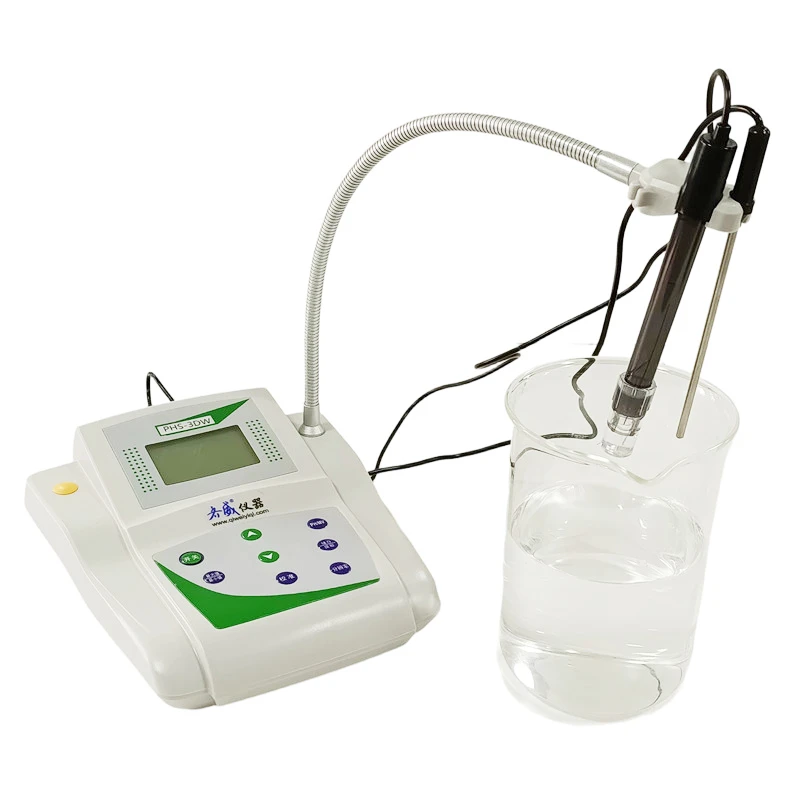
Hangzhou Qiwei Instrument Co., Ltd. is one of the leading manufacturers and suppliers of laboratory benchtop ph meter in China. With a professional production team, we are able to meet the needs of the majority of our customers. Welcome to wholesale bulk laboratory benchtop ph meter in stock here from our factory. We also accept customized orders.
Benchtop pH measuring instruments are widely used lab devices to determine the acidity and alkalinity of samples within standardized test environments. When research labs, pharmaceutical QA/QC departments and independent third-party testing agencies source such equipment, readings alone are far from the only factor to weigh. Measurement consistency, claimed accuracy, verification protocols, electrode compatibility, applicable temperature ranges and data recording needs collectively decide if a unit can integrate smoothly into existing lab operations.
Qiwei supplies benchtop pH testing systems tailored for routine lab analysis and quality control inspection. Models including PHS‑25/25C and PHS‑2C support pH detection from 0.00 to 14.00 with a readout resolution of 0.01 pH, while their accuracy specifications differ by model. Customers are advised to cross-check these published parameters against their internal test protocols prior to final purchase.
product key technologies

Laboratory benchtop pH meters are laboratory devices for determining pH and millivolt readings of liquid samples. When hydrogen ions move in aqueous media, the combined pH electrode captures their activity and turns it into electric signals. The signals are transmitted to the device, where they are calculated, amplified and validated step by step. An analog-to-digital (A/D) converter then outputs the final readings on a digital display. The electrical responses produced in this whole process abide by the Nernst equation.
Before choosing a model, prepare a list of required measurement performance, calibration points, temperature compensation, electrode types, data interfaces, and documentation. If the instrument will be used for regulated or audited testing, verify each requirement against the actual model specification and the documentation supplied by the manufacturer.

Working Condition
|
Environmental Temperature |
5~40℃ |
|
Relative Humidity |
≤80% |
|
The Temperature Of The Measured Solution |
5 ~ 60 °C |
|
Power Supply |
220V/50Hz |
|
Interference |
No significant vibration and strong electromagnetic field interference. |
Technical parameters
|
Instrument type |
PHS-25/25C |
PHS-2C |
|
Measurement range |
0.00 ~14.00 PH; ±1999 mV |
|
|
Precision |
±0.05 PH |
±0.02 PH |
|
Resolution |
0.01PH |
|
|
Measurement accuracy |
±10 mV |
±10 mV |
|
Resolution |
1 mV |
|
|
Temperature compensation range |
0~60°C |
|
|
Standard buffer solution |
PH4.00/6.86/9.18 or PH4.00/7.00/10.01 |
|
|
Power Supply Type |
Regulated power adapter, or power cord |
|
|
Size |
220×200×85mm |
|
|
Weight |
About 1.6 kg |
|
Calibration Certificate and Technical Documentation
When laboratories make purchasing decisions, the availability and scope of supporting documentation carry equal weight alongside an instrument's technical performance. Buyers ought to confirm which papers come standard with the chosen model and which can be provided separately on request before issuing a purchase order.
Documents to Confirm
1. Product Operation Manual: Contains operational instructions, technical guidance, verification methods, electrode specifications and troubleshooting support.
2. Calibration Certificate: Check whether this certificate is provided. Clarify if it corresponds to the individual unit instead of a generic reference standard, and confirm whether it contains accreditation information, test data, acceptance benchmarks and traceability records as needed.
3. Factory Test Reports: Confirm whether factory outgoing inspection records or supplementary quality paperwork can be offered for the selected item and ordered configuration.
4. Communication Interface Specifications: If electronic data export is needed, confirm compatible software, communication parameters, deployment prerequisites and supported data formats.
Key Purchase Reminder
The provision, layout, traceability and coverage of verification documents vary by product model and the manufacturer's documented service capacity. Do not presume these certification papers are automatically included unless this arrangement is confirmed in writing. Clients operating under quality frameworks for pharmaceutical, research or third-party testing work are recommended to examine document contents ahead of order confirmation.
Usage & Maintenance
1. Calibration is essential for accurate pH readings. A three‑point calibration with standard buffer solutions is required before measurement.
2. The pH testing process consists of three stages: preparation, measurement and post‑test handling. Start by activating the electrode and inspecting its status. Then prepare your sample, immerse the electrode into the liquid, run the test, log steady readings and complete measurement. Once testing is done, rinse the electrode properly and store it correctly.
3. Routine maintenance mainly focuses on electrode upkeep and instrument safeguarding. For short‑term storage, the electrode shall be soaked in 3 mol/L KCl solution or dedicated preservation liquid. If the device will stay unused for an extended period, fully dry the electrode ahead of storage. Keep the host meter in a dry environment and perform calibration on a regular basis. Remember to fit the protective cap after every use.
4. If the electrode gets contaminated, choose a suitable cleaning solvent according to the nature of the contaminants for cleaning.
FAQ
1. What acidity resolution does this lab benchtop pH meter offer?
The published specs for the PHS-25/25C and PHS-2C listing a acid quality of 0.01 pH. If your technique requires 0.001 acid quality, contact QiweiLab to verify the availability of a suitable model.
2. Is this acidity meter suitable for medical QA/QC facilities?
It may be appropriate for lab pH measurement when its published specifications meet the relevant test method. Buyers should check dimension performance, electrode interoperability, calibration procedures, and documentation requirements before use.
3. Does the sensor automatically compensate for trial temperature?
The published item information listings a heat settlement range of 0–60°C. Confirm the particular payment method and the heat probe requirements for the selected configuration.
4. How can I get a professional manual or product quotation?
Call QiweiLab with your intended program, goal model, required efficiency, documentation needs, and estimated order quantity. The sales team can confirm the applicable specifications and offer a quotation based on the requested construction.
Hot Tags: laboratory benchtop ph meter, China laboratory benchtop ph meter manufacturers, suppliers, factory, Handheld PH Meter, ph meter, Portable PH Pen