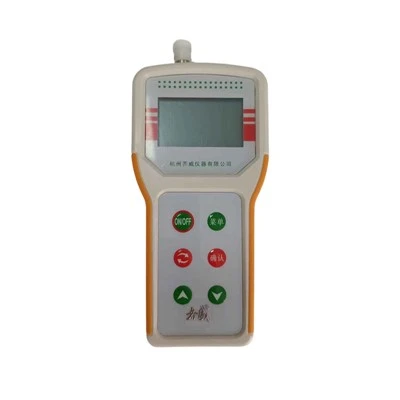
Hangzhou Qiwei Instrument Co., Ltd. is one of the leading manufacturers and suppliers of benchtop multi-parameter nitrate ion concentration meter in China. With a professional production team, we are able to meet the needs of the majority of our customers. Welcome to wholesale bulk benchtop multi-parameter nitrate ion concentration meter in stock here from our factory. We also accept customized orders.
The PXS-NO3 Benchtop Nitrate Ion (NO3-) Concentration Meter is designed for laboratory measurement of nitrate ions in prepared aqueous samples.
Nitrate analysis is commonly required in environmental water testing, agricultural research, soil extracts, irrigation water, wastewater analysis, and laboratory studies of nutrient loading.
When combined with a compatible nitrate ion-selective electrode, the meter can be incorporated into laboratory workflows where nitrate concentration needs to be measured, compared, and recorded under controlled conditions.
The instrument is intended for nitrate ion measurement rather than general nitrogen analysis. Users should distinguish nitrate ion (NO3-) concentration from nitrate-nitrogen (NO3--N) reporting before comparing results with laboratory or regulatory data.
product key technologies

The PXS-NO3 Benchtop Multi-Parameter Nitrate Ion Concentration Meter is professionally developed for the content detection of nitrate ions in water bodies. It is widely applicable to university teaching and research, scientific research institutes, petrochemical, microelectronics and other related industries. It can perform accurate detection and analysis of nitrate ion concentration and activity in various water samples, including natural water, laboratory pure water and industrial wastewater.
Nitrate Ion Testing for Water and Soil
The source and makeup of a sample can greatly affect the concentration of nitrate.
While agricultural laboratories may detect nitrate in soil extracts or irrigation-related samples, environmental laboratories may test nitrate in surface water, groundwater, treated water, or wastewater.
The following laboratory operations can be supported by a tabletop nitrate ion meter:
1. Testing of environmental water
2. Analysis of groundwater
3. Testing of surface water
4. Characterization of wastewater
5. Analysis of soil extract
6. Testing of irrigation water
7. Research on agriculture
8. Research on nutrient management
The prepared liquid sample's nitrate content is measured by the meter. Prior to measuring nitrate, solid soil samples must undergo the proper extraction process.
Technical parameters
|
Model |
PXS-NO3 |
|
Measuring Range |
pNO3: (0.00~6.00)pNO3; NO3-1: 0.19μg/L~19g/L; mV: (-1800~1800)mV |
|
Resolution |
0.01pNO3 |
|
Basic Error of the Electronic Unit |
±0.02 pNO3 ±1 word |
|
Instrument Basic Error |
±0.05 pNO3 |
|
Calculation Error |
±0.3% |
|
Repeatability Error |
≤±0.03 pNO3 ±1 word |
|
Stability of the Electronic Unit |
±0.02 pNO3/3h |
|
Temperature Compensation Range |
(5.0~50.0)℃ |
|
Size |
210×190×80mm |
|
Weight |
1.5KG |
Multi-Point Nitrate Calibration Procedure
Multi-point calibration can be applied to laboratory nitrate analysis when observations span a wide range of concentrations.
Step 1: get the nitrate standards ready.
Create a set of nitrate standards that span the samples' anticipated concentration range.
Step 2: Implement Uniform ISA Requirements
If ISA is needed, follow the instructions to add it to each calibration standard.
Step 3: Choose the Correct Standard First
The specified concentration sequence provided by the electrode manufacturer should be followed for measuring the calibration standards.
Step 4: Let the Reading Level Out
Prior to accepting each calibration point, wait for a steady electrode response.
Step 5: Construct the Calibration Curve
Note the electrode response in relation to each standard's nitrate concentration.
Step 6: Examine the Calibration Response
Before moving on to unknown samples, examine the calibration slope and response.
Step 7: Measure the Samples
Prepare unidentified samples in a manner similar to that of the calibration standards.
Errors brought on by variations in sample preparation, ionic strength, or electrode conditioning can be minimized with a standardized calibration process.
Working condition
|
Ambient Temperature |
(5~40)℃ |
|
Relative Humidity |
≤80% |
|
Power Supply |
AC 220V ± 22V; Frequency 50 ± 1HZ |
|
Interference |
There is no interference from other magnetic fields except the Earth's magnetic field |
|
Vibration |
No significant vibration |
Features
- The PXS-NO3 benchtop multi-parameter nitrate ion concentration meter is built with an intelligent main control chip. It features simple and user-friendly operation. High-definition digital direct reading delivers clear, stable and highly accurate measurement values.
- The instrument adopts an intelligent temperature correction system, with switchable automatic sensing and manual setting modes. When an external temperature sensor probe is connected, it collects ambient temperature in real time and performs intelligent calibration. Without the probe, users can customize temperature parameters to finish calibration. The temperature probe is a non-standard optional accessory; buyers may specify the requirement in advance when placing an order.
- The device not only clearly displays the pNO3 measurement index, but also directly shows the nitrate ion concentration value. It also supports detection and display of the corresponding ion concentration potential.
- With a simple and elegant overall design, the unit is slim, compact and space-saving, making it extremely convenient for placement and transportation.
How to Use a Nitrate Calibration Curve?
An electrochemical reaction associated with nitrate activity is generated by a nitrate ion-selective electrode.
The link between electrode response and concentration is established during calibration by measuring known nitrate standards.
Operators should examine the following for routine testing:
1.Consistency of calibration points
2.Stability of electrode response
3.Slope of calibration
4.Range of standard concentrations
5.Sample concentration in relation to the calibration range
6.Condition of the electrode
Instead of extrapolating the result without verification if the sample result is outside the calibrated range, dilute the sample or determine an acceptable calibration range based on the analytical method.
FAQ
1.What distinguishes NO3- from NO3--N?
NO3--N expresses the nitrogen component of nitrate, whereas NO3- denotes the concentration of nitrate ions. The two values have distinct numerical values because they employ separate reporting bases.
2.How can I change NO3--N into NO3-?
To determine the corresponding nitrate ion concentration, multiply the NO3--N value by around 4.4268.
3.Is it possible to test nitrate in soil using this meter?
Nitrate in liquid samples is measured using the meter. An appropriate soil-testing process should be used to extract soil samples initially.
4.Does measuring nitrate require ISA?
The chosen nitrate ion-selective electrode and analysis technique determine the ISA requirements. Adhere to the formulation and addition instructions provided by the electrode manufacturer.
5.What makes multi-point calibration beneficial?
When sample concentrations differ greatly, multi-point calibration is helpful in determining the electrode response over a certain concentration range.
6.Is it possible to report nitrate values asNO3--N?
The laboratory procedure, measurement technique, and instrument design determine the reporting foundation. Before reporting, users should verify if the computed or displayed value represents NO3- or NO3--N.
7.Is it possible to use this device for ISO or EPA testing?
Regulatory compliance depends on the entire method, sample preparation, calibration, quality-control procedure, and laboratory requirements. However, the meter may be integrated into a laboratory workflow based on an appropriate analytical method.
8.Is it possible to export measurement data?
The particular instrument setup determines the data export capability. Before making a purchase, confirm the software requirements and the available connection interface.
Hot Tags: benchtop multi-parameter nitrate ion concentration meter, China benchtop multi-parameter nitrate ion concentration meter manufacturers, suppliers, factory, Benchtop Multi Parameter Chlorine Ion Concentration Meter, Benchtop Multi Parameter Nitrate Ion Concentration Meter, Portable Multi Parameter Cadmium Ion Concentration Meter, Portable Multi Parameter Calcium Ion Concentration Meter, Portable Multi Parameter Kalium Ion Concentration Meter, Portable Multi Parameter Sodium Ion Concentration Meter