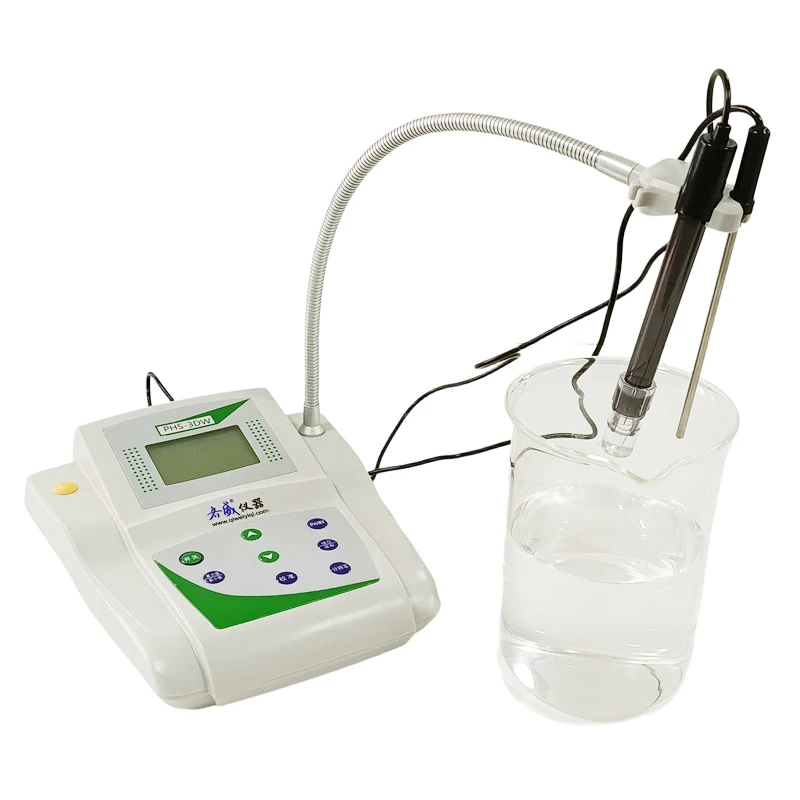
Water quality analyzers primarily employ ion-selective electrode measurement for accurate detection. The instrument includes electrodes for pH, fluoride, sodium, potassium, calcium, magnesium, and a reference electrode. Each electrode has an ion-selective membrane that reacts with the corresponding ions in the sample. The membrane acts as an ion exchanger; the reaction with ionic charges alters the membrane potential, allowing the detection of the potential between the solution, sample, and membrane. The potential difference between the two detected sides of the membrane generates a current. The sample, reference electrode, and reference electrode solution form one "loop," while the membrane, internal electrode solution, and internal electrode form the other.
The ion concentration difference between the internal electrode solution and the sample generates an electrochemical voltage across the membrane of the working electrode. This voltage is transmitted to the amplifier via the highly conductive internal electrode, and similarly, the reference electrode is also connected to the amplifier. A calibration curve is obtained by measuring a standard solution with a precise known ion concentration, thereby determining the ion concentration in the sample.
When the analyte ions in the solution come into contact with the electrode, ion migration occurs within the aquifer of the ion-selective electrode matrix. The change in charge of migrating ions creates a potential, which in turn causes a change in the potential between the membrane surfaces, generating a potential difference between the measuring electrode and the reference electrode.