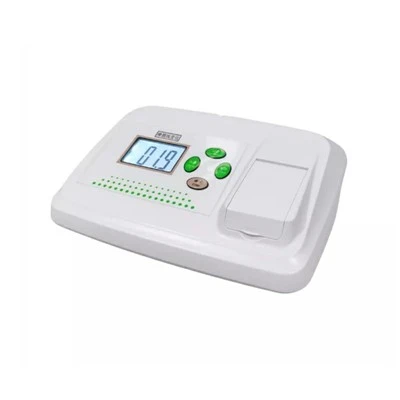
Hangzhou Qiwei Instrument Co., Ltd. is one of the leading manufacturers and suppliers of benchtop turbidity meter in China. With a professional production team, we are able to meet the needs of the majority of our customers. Welcome to wholesale bulk benchtop turbidity meter in stock here from our factory. We also accept customized orders.
The WGZ-AS and WGZ-BS Benchtop Turbidity Meter Series offers multiple instrument configurations for laboratories that need to measure water sample turbidity across different measurement ranges.
Rather than selecting a turbidity meter based on its model name alone, users should compare the required measurement range, minimum indication, instrument dimensions and testing requirements. The WGZ series provides different model options to support this selection process.
This page focuses on model comparison, range selection and routine laboratory testing workflows to help buyers identify a suitable benchtop turbidity meter for their applications.
product key technologies

The WGZ‑AS and WGZ‑BS benchtop turbidity analyzers rely on the mature nephelometric scattered‑light principle to offer high‑precision turbidity analysis for liquid specimens. Every unit is calibrated using internationally accepted formazin reference standards to align test outputs with global mainstream requirements. This guarantees traceable calibration and excellent consistency across all measurement readings.
Though categorized as a premium turbidity instrument, its key advantage lies in reliable linear response covering the full measurement range. It maintains stable optical signals for both low‑turbidity purified water and moderately turbid circulating water, producing precise, reproducible readings. Operation is intuitive as well. Complicated configuration steps are eliminated, so laboratory operators can get started without extensive training.
This instrument suits permanent installation inside professional water quality laboratories, ideal for routine tests and batch sample analysis. Applicable scenarios include water treatment works, water reuse stations, swimming pool circulation systems, as well as quality control links within food and beverage manufacturing lines.
Developed to support lab setup and day-to-day inspection routines, the analyzer maintains steady long-run performance and solid resistance to external disturbances. It can detect minute suspended particulates in water with high sensitivity, faithfully track shifts in turbidity levels, and supply reliable data to back up water quality assessment, process tuning and regulatory acceptance checks. The benchtop turbidity meter stays free of signal drift even under continuous heavy-duty testing.
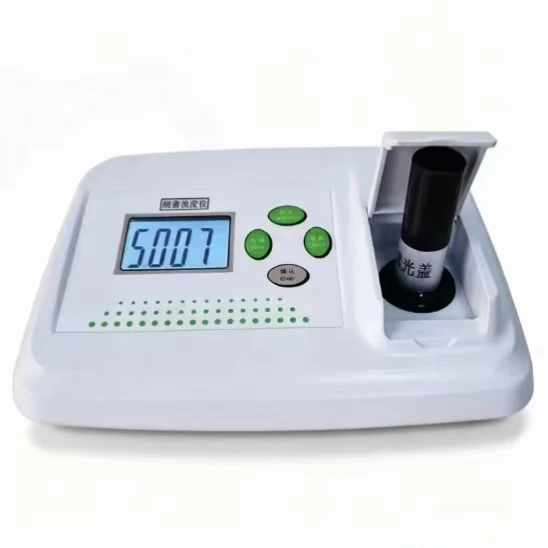
Technical Parameter
Series A
|
Model |
WGZ-200AS |
WGZ-400AS |
WGZ-500AS |
WGZ-800AS |
WGZ-1000AS |
|
Principle |
90° scattered light |
||||
|
Measuring Range |
0-200 NTU |
0-400 NTU |
0-500 NTU |
0-800 NTU |
0-1000 NTU |
|
Minimum |
0.1 NTU |
||||
|
Calibration |
4 |
5 |
6 |
6 |
7 |
|
Indication Error |
±6% (±2% FS) |
||||
|
Repeatability |
≤0.5% |
||||
|
Zero Drift |
±0.5% FS |
||||
|
Weight |
0.5kg |
||||
|
Size |
200×270×80mm |
||||
|
Power Supply |
AC 220V/50HZ / DC 7.5V/0.2A |
||||
|
Feature |
Microcomputer configuration, featuring average measurement mode, with data storage and query functions, and automatic range switching. |
||||
Series B
|
Model |
WGZ-200BS |
WGZ-400BS |
WGZ-500BS |
WGZ-800BS |
WGZ-1000BS |
|
Principle |
90° scattered light |
||||
|
Measuring Range |
0-100/0.01 NTU 100-200/0.1 NTU |
0-100/0.01 NTU 100-400/0.1 NTU |
0-100/0.01 NTU 100-500/0.1 NTU |
0-100/0.01 NTU 100-800/0.1 NTU |
0-100/0.01 NTU 100-1000/0.1 NTU |
|
Minimum |
0.1/0.01 NTU |
||||
|
Calibration |
2 |
5 |
6 |
6 |
7 |
|
Indication Error |
±6% (±2% FS) |
||||
|
Repeatability |
≤0.5% |
||||
|
Zero Drift |
±0.5% FS |
||||
|
Weight |
2.5kg |
||||
|
Size |
400×300×250mm |
||||
|
Power Supply |
AC 220V/50HZ |
||||
|
Feature |
Microcomputer configuration, featuring average measurement mode, with data storage and query functions, and automatic range switching. |
||||
McFarland Turbidity Checks in Microbial Inoculum Preparation
Microbiology labs often prepare bacterial suspensions and tune their turbidity to a set value ahead of follow-up experiments. The required McFarland standard depends on the bacterial strain, adopted assay and the lab's internal SOP.
The WGZ-XT simplifies this preparation work by outputting readings directly in McFarland units.
Making the bacterial suspension: Prepare the microbial suspension following your lab's approved culturing and sample-making protocol.
Turbidity measurement: Load the specimen into the matched cuvette and take the McFarland reading as guided by the instrument instructions.
Comparison against the target: Check whether the obtained value matches the McFarland level specified in your microbiology test protocol.
Logging test information: Save the sample ID, measured McFarland reading, preparation timestamp and other relevant test details in lab records.
This process enables technicians to check suspension density before carrying out further microbiological tests. It is important to note that this device cannot substitute viable colony counting, nor does it waive any validation rules stated in your test standard.
Routine Workflow for Batch Turbidity Testing
Food manufacturing QC labs and wastewater treatment plants often collect specimens from different production lots or process points for turbidity checks. A fixed testing sequence helps technicians arrange tests systematically and assess measurement outcomes more efficiently.
1. Sample Preparation & Marking
Tag every sample clearly to indicate its origin, sampling time, production batch or treatment stage. Follow the specified test method to homogenize or condition the sample properly.
2. Preparation of the Sample Cell
Use the dedicated sample cell matched to this instrument. Inspect its optical surfaces for fingerprints, scratches or leftover contaminants, and confirm the outer wall is fully dry and spotless.
3. Sample Testing in a Fixed Order
Insert the sample cell into the instrument following the operation guidelines. Apply identical handling and placement steps for every specimen to maintain stable testing conditions.
4. Result Check and Documentation
Select the target measurement mode and retrieve stored data supported by your instrument model. Log the sample ID and corresponding turbidity values into the lab's quality control records.
5. Cell Cleaning Prior to Subsequent Tests
Clear residual sample liquid from the cell to get it ready for the next run. For ultra-low turbidity samples, extra care is required to eliminate fingerprints, water droplets and cross-contamination from prior specimens, all of which can skew optical readings.
How to Select a WGZ-AS or WGZ-BS Benchtop Turbidity Meter?
Two key points deserve top priority for labs shopping for a benchtop turbidity meter: what kind of test data they hope to obtain, plus the turbidity levels they expect to see in their samples.
Decide on an appropriate measurement span
The WGZ lineup provides options with 200 NTU and 1000 NTU full scales. When making your selection, assess both the usual turbidity of your samples and their highest possible readings. Matching the range properly prevents investing in an instrument unable to meet your test needs.
Examine the lower detection limit
The WGZ‑AS has its own minimum detectable turbidity value. The WGZ‑BS can resolve down to 0.01 NTU, making it fit for ultra-low turbidity applications. Buyers need to cross-reference each model's technical indicators against the resolution demanded by their test protocols.
Assess on-site placement conditions
AS and BS units differ in physical dimensions and weight. Before placing an order, double-check that your lab bench area, power supply setup and layout can accommodate the instrument.
Clarify your data management expectations
Automatic range adjustment, data archiving, record search and averaging measurement mode are built into both series. If your lab requires special output interfaces, PC communication or customized data export formats, confirm these available options with the supplier before purchase.
When sending your quotation request, describe the turbidity range of your samples, how often you run tests and other lab requirements. This helps our team recommend the most suitable model for you.
FAQ
1. Why are the turbidimeter readings unstable?
Unstable readings of a turbidimeter are not necessarily caused by faults of the instrument itself. Improper operation can also lead to fluctuating measurements. If the liquid sample contains excessive air bubbles, the test values will be affected. Therefore, always wait until all bubbles dissipate before conducting turbidity measurement.
Another cause of unstable readings is liquid clinging to the sample cup during sample transfer. When droplets remain inside the cup or on its outer wall, light scattering will be interfered with, resulting in inaccurate test results. To solve this problem, wipe the sample cup thoroughly with filter paper prior to measurement.
2. What are the solutions when the power indicator light goes out?
Check whether the power plug is fully inserted and the socket makes good contact. Try changing the socket or re-plugging the power cord. Replace the fuse if it is blown.
3. Why should the sample cell be cleaned before each measurement?
Fingerprints, droplets, scratches, and sample residue can interfere with the optical measurement path. Clean and inspect the sample vessel according to the operating instructions before testing.
Hot Tags: benchtop turbidity meter, China benchtop turbidity meter manufacturers, suppliers, factory, Beer Turbidity Meter, Benchtop Digital Turbidity Meter, Laboratory Benchtop Turbidity Meter, Laboratory Portable Turbidity Meter, Portable Bacterial Turbidity Meter, Portable Turbidity Meter